A friendly, step-by-step guide to mixing, rolling, and cooking homemade gluten-free pasta with the best flour blends and binders so it stays tender, not crum...
recipes
Updated September 21, 2026
Authentic Italian Fresh Pasta (Step by Step)

Maya Chen
Maya Chen is a passionate home cook, recipe developer, and mother of two who believes that great food doesn't have to be complicated. Drawing from her multicultural upbringing and time spent in professional test kitchens, she creates approachable, flavor-packed recipes designed for real life.
Sizzlea
recipes
Fresh pasta is one of those kitchen flexes that looks wildly impressive and is secretly very doable. Yes, your counter will get a little floury. Yes, you will probably have a tiny bit of dough stuck to your knuckle at some point. That is part of the charm.
This guide walks you through traditional Italian-style fresh pasta from scratch, with the details that actually matter: which flour to use, what the dough should feel like, how long to knead, how to roll it thin without stress, and how to cook it so it stays silky, not gummy.
Before you start: what makes it “authentic”?
Italy has a whole beautiful world of pasta traditions, but for home cooks, traditional fresh pasta usually means one of these classic dough styles:
- Egg pasta (pasta all’uovo): Flour plus eggs. Rich, silky, and ideal for tagliatelle, fettuccine, pappardelle, and stuffed pasta.
- Semolina-water pasta: Durum semolina plus water (sometimes a pinch of salt). No eggs, a bit more chew, and great for shapes like orecchiette, cavatelli, and many southern styles.
In this article, we will focus on the most versatile starter dough: classic egg pasta. I will also give you a simple semolina-water option if eggs are not your thing.
Ingredients: flour matters
Best flour for egg pasta
If you want that tender, restaurant-style bite (tender, but not mushy), flour choice is the quiet hero.
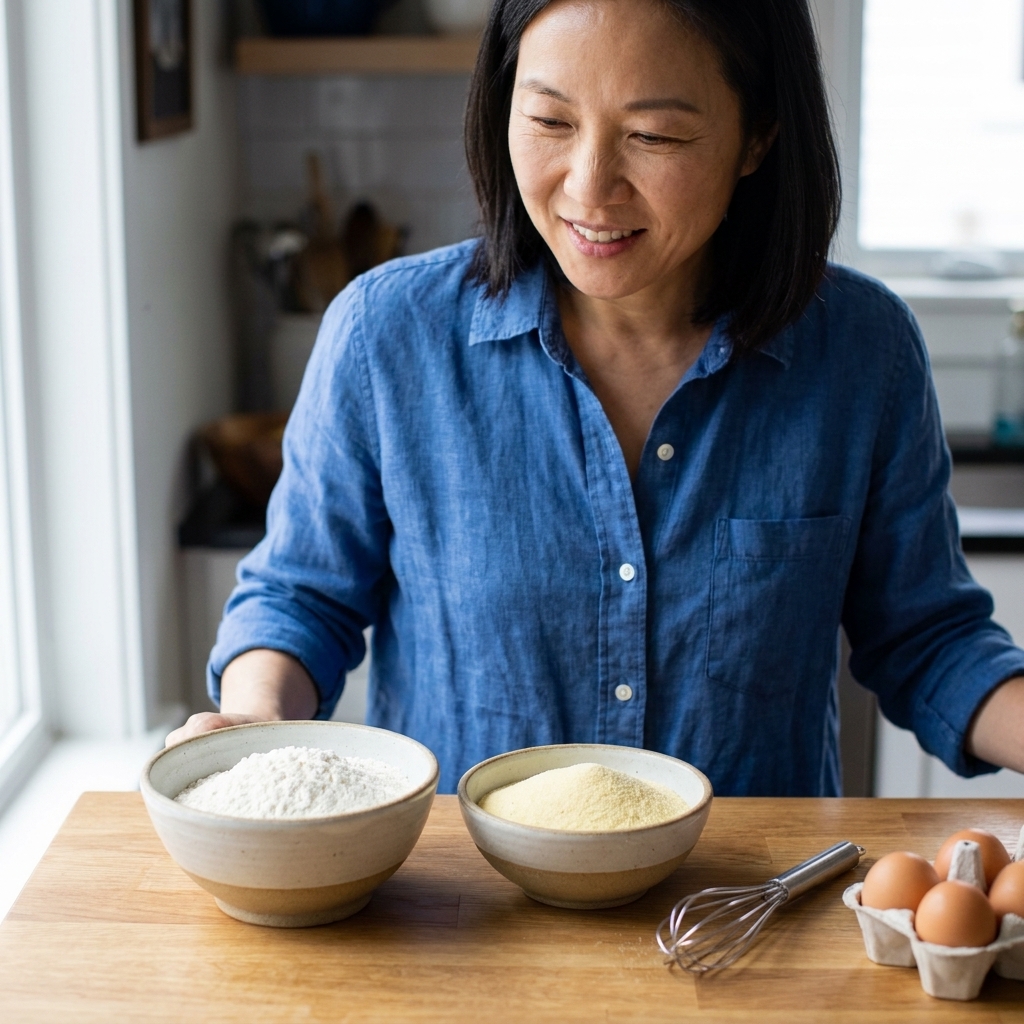
- 00 flour: The classic for many egg doughs. It is finely milled so it rolls beautifully and helps you get a smooth, supple sheet. Quick note for the nerds (said with love): “00” refers to fineness, not protein, and different brands can behave differently.
- All-purpose flour: Totally works. Slightly more rustic texture, still delicious and very beginner-friendly.
- Semolina (durum) flour: More chew and a little grit. Great blended with 00 or all-purpose for strength.
My go-to mix for “traditional but forgiving”: 70% 00 (or all-purpose) + 30% semolina. You get silky rolling plus that subtle, satisfying bite.
Eggs: size and freshness
Use large eggs. Fresh eggs can make kneading easier and the color more golden. That said, supermarket eggs still make wonderful pasta.
Salt and olive oil?
Traditional egg pasta dough often has no salt because the pasta water is salted instead. Olive oil is optional. It can make the dough feel a little softer and easier to handle, but it is not a replacement for proper hydration, and it can slightly mellow gluten development. I skip it for classic egg dough, but a teaspoon is fine if you like the feel.
One more thing: Humidity and seasons matter. Flour absorbs moisture differently in July than it does in January. That is why pasta dough is always part recipe, part vibe check.
Fresh egg pasta dough (master recipe)
This is the base recipe I come back to again and again.
Ingredients (serves 4)
- 300 g flour (00, all-purpose, or a mix like 210 g 00 + 90 g semolina), plus more for dusting
- 3 large eggs (about 150 g without shells)
- Optional: 1 to 2 tsp water if needed
About the ratio: A very classic starting point is 100 g flour per 1 large egg. This recipe follows that. Still, eggs vary, flours vary, and your kitchen has moods. Use this as a reliable starting point and adjust by feel with a teaspoon of water or a light dusting of flour.
Tools
- Kitchen scale (highly recommended)
- Fork
- Bench scraper (or a sturdy spatula)
- Rolling pin and/or pasta machine
- Clean kitchen towel or plastic wrap
- Sheet pan (for holding pasta)
Why grams? Pasta dough is all about feel, but a scale gets you in the right neighborhood fast so you are not playing “add flour forever.”
Step-by-step: make the dough
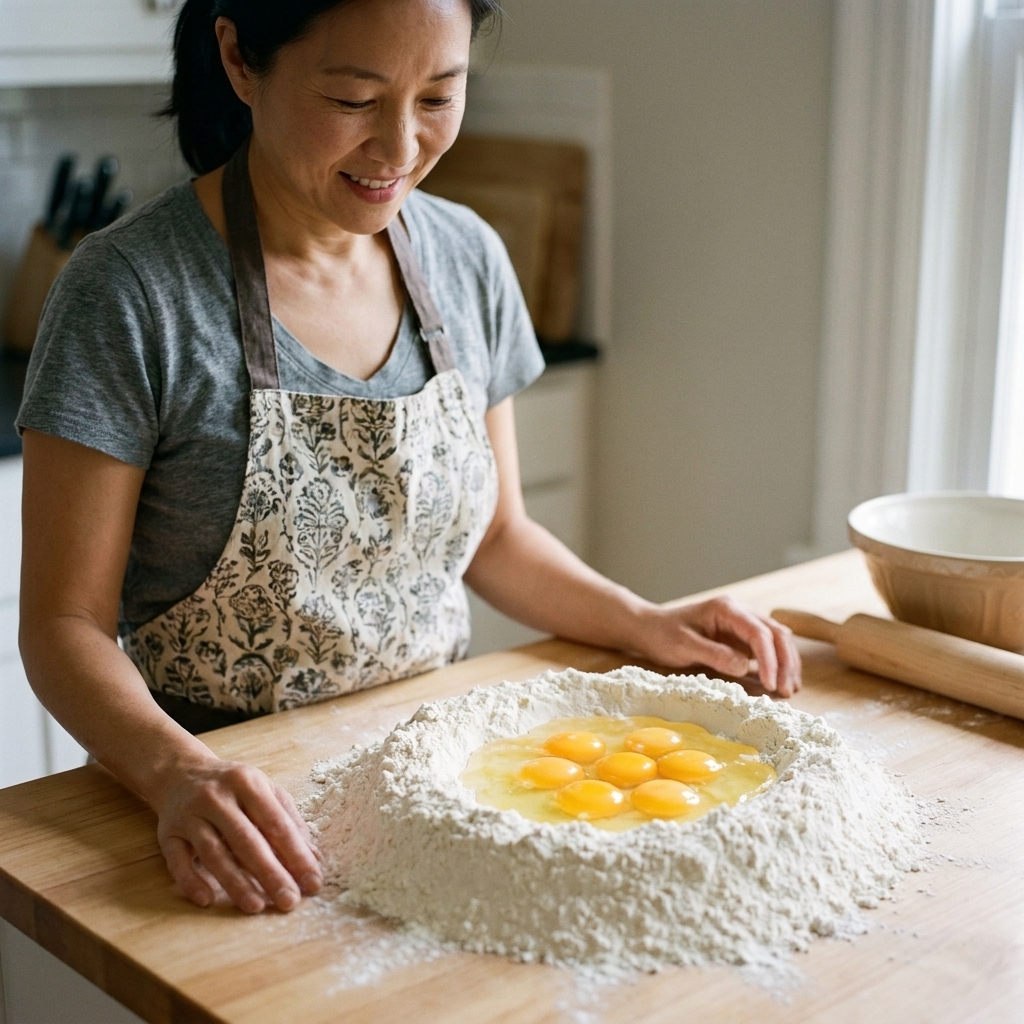
1) Make a flour well
Pile the flour on a clean counter and make a wide well in the center. Crack the eggs into the well.
2) Whisk, then pull in flour slowly
Use a fork to whisk the eggs, gradually dragging flour from the inner walls of the well into the eggs. Go slowly at first. Once it turns into a thick batter, you can start folding more flour in with the bench scraper.
3) Bring it together
When it looks shaggy and clumpy, use your hands to press it into a rough dough. If there is loose flour that refuses to join, that is okay. Do not force every last gram in. Egg size and flour absorbency decide how much flour the dough actually wants.
If it is crumbly and will not hold, add 1 teaspoon water and knead it in.
4) Knead until smooth
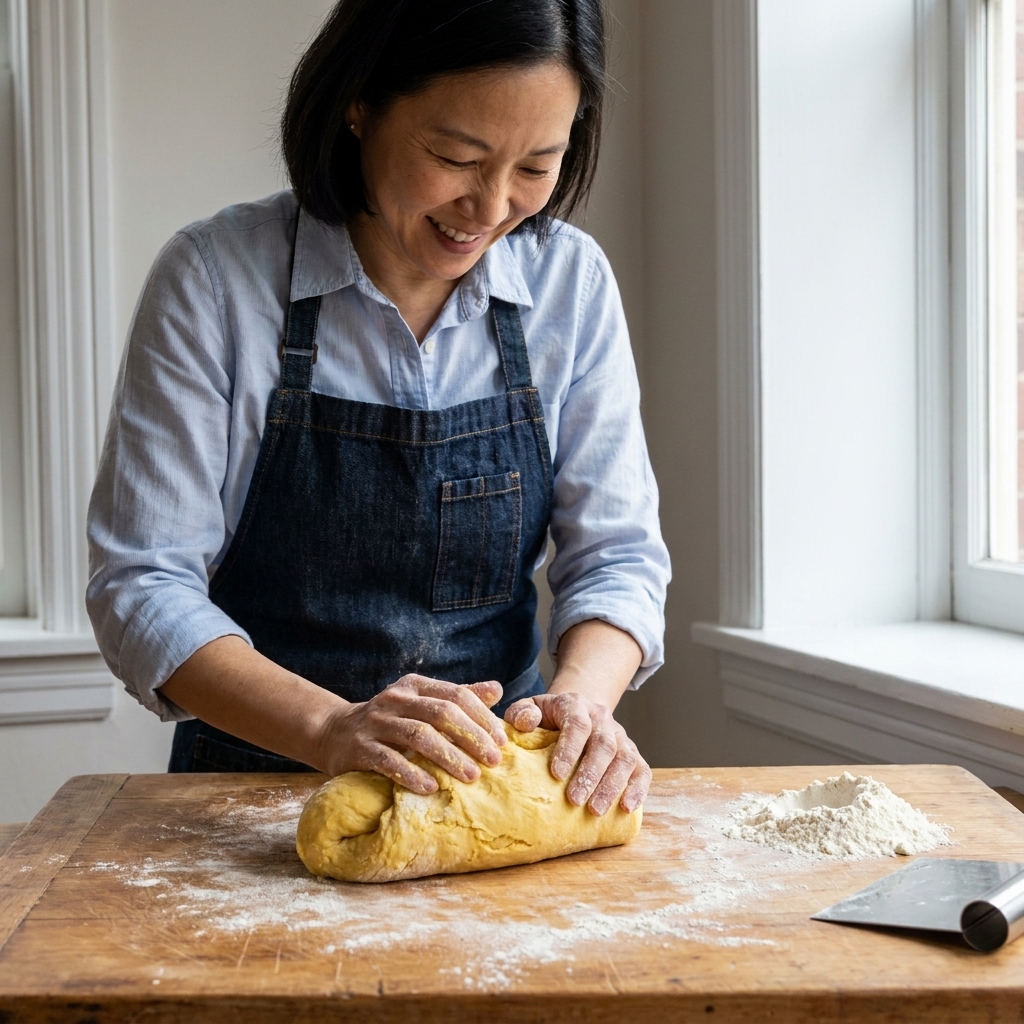
Knead for 8 to 10 minutes. Push with the heel of your hand, fold, rotate, repeat. The dough should become smooth, elastic, and only slightly tacky.
What you are looking for:
- Too dry: cracking edges, feels like it is fighting you, will not smooth out. Add water 1 tsp at a time, then give it a few minutes of kneading to catch up.
- Too wet: sticky and smears on the counter. Dust with a little flour and keep kneading.
5) Rest the dough (do not skip)
Wrap tightly and rest at room temp for 30 minutes (up to 2 hours). This relaxes the gluten, making rolling dramatically easier and the dough smoother.
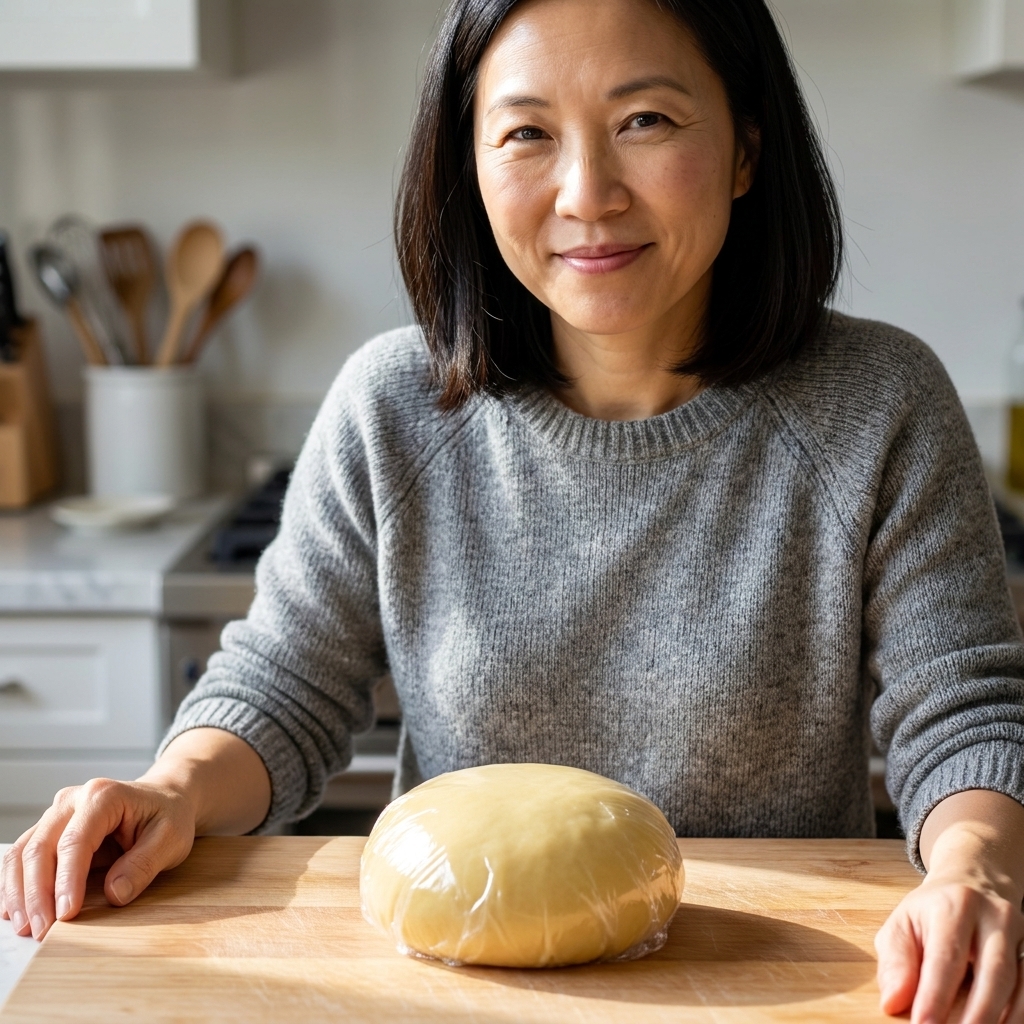
Make-ahead: Refrigerate up to 24 hours. Bring back to room temperature for about 30 to 60 minutes before rolling.
Rolling: pin or machine
Option A: Roll by hand
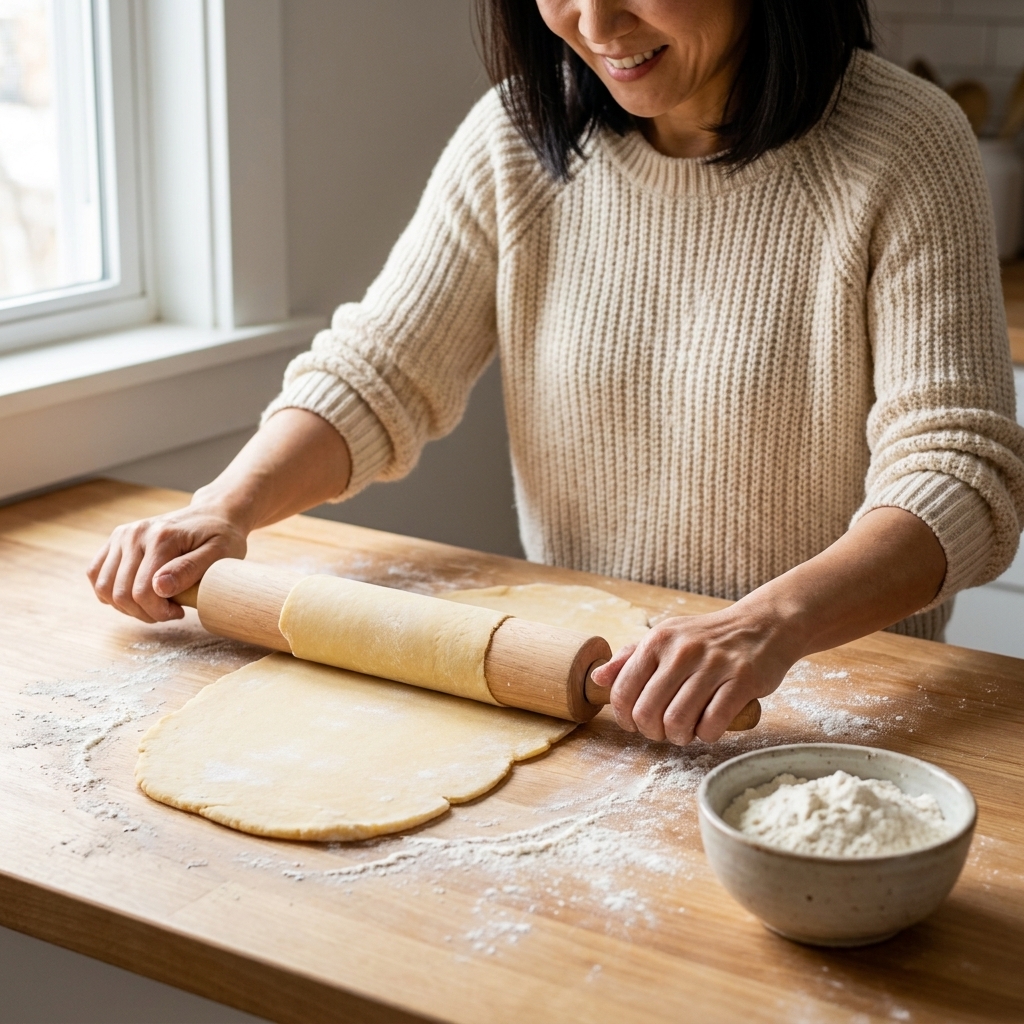
Lightly flour the counter. Cut the dough into 4 pieces and keep the rest covered. Roll one piece into a thin sheet, turning and flipping as you go.
- Start from the center and roll outward.
- Rotate the dough often to keep it even.
- Dust lightly as needed. Too much flour can make the dough skate around and dry out.
How thin is thin enough? For noodles, aim for about the thickness of a playing card, or thin enough to see the shadow of your hand through it when held up to light. For a more concrete target, many noodles land nicely around 0.8 to 1.0 mm.
Option B: Roll with a pasta machine
Flatten one dough piece into a rectangle. Run it through the widest setting. Fold into thirds like a letter, rotate 90 degrees, and run through again. Do this 2 to 3 times to smooth it out, then keep reducing the thickness one notch at a time.
- Do not rush from thick to thin. The gradual steps create a strong, silky sheet.
- If the sheet gets too long, cut it in half and keep going.
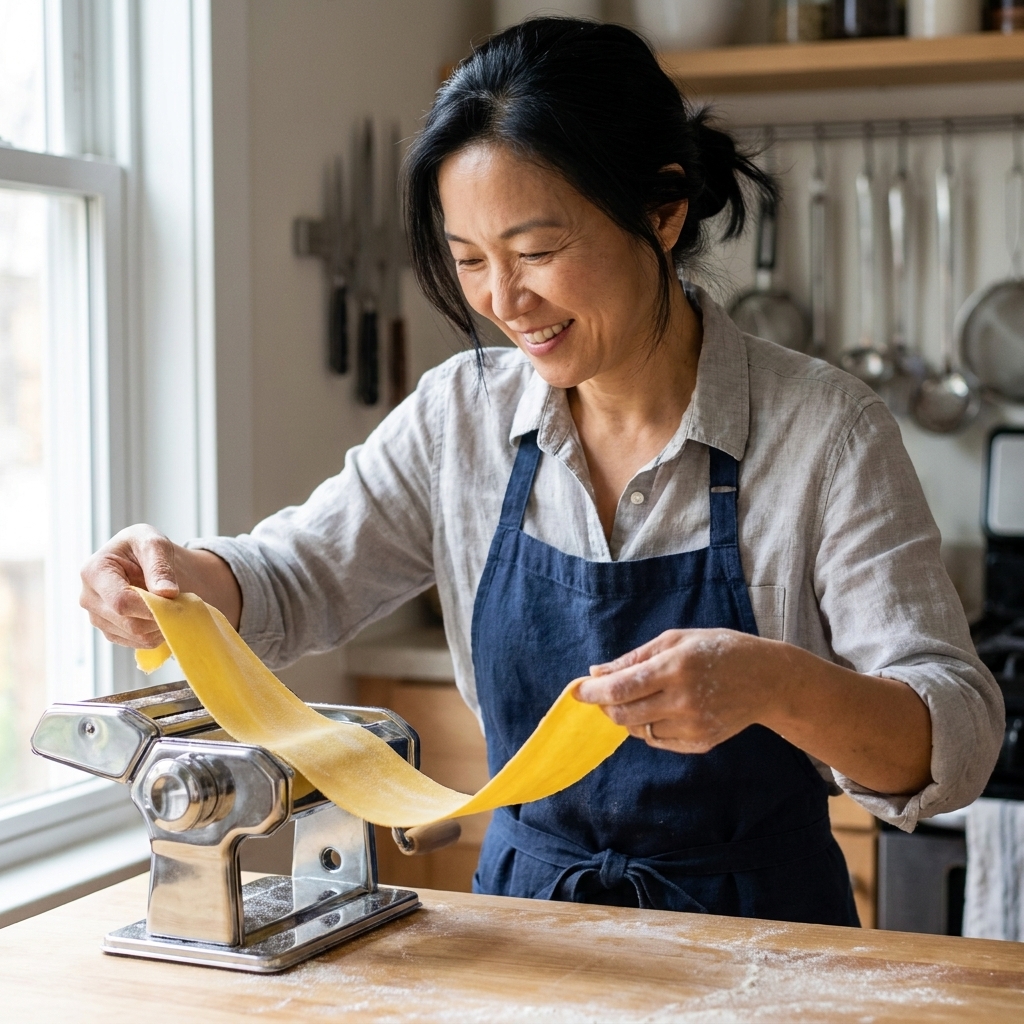
Thickness guide (general):
- Tagliatelle/fettuccine: setting 5 to 6 on many machines, roughly 0.9 to 1.1 mm
- Ravioli: setting 6 to 7, roughly 0.6 to 0.8 mm
- Lasagna sheets: setting 6, roughly 0.8 to 1.0 mm
Every machine is a little different, so use these as starting points and adjust to your preference.
Shaping: easy weeknight wins
Tagliatelle or fettuccine
Lightly dust the sheet with flour. Loosely fold it into a flat roll (like a soft scarf, not tight like a cigar). Slice into ribbons.
- Tagliatelle: about 6 to 8 mm wide
- Fettuccine: about 5 to 6 mm wide
- Pappardelle: 2 to 3 cm wide
Unfurl and toss gently with a little flour or semolina to prevent sticking.
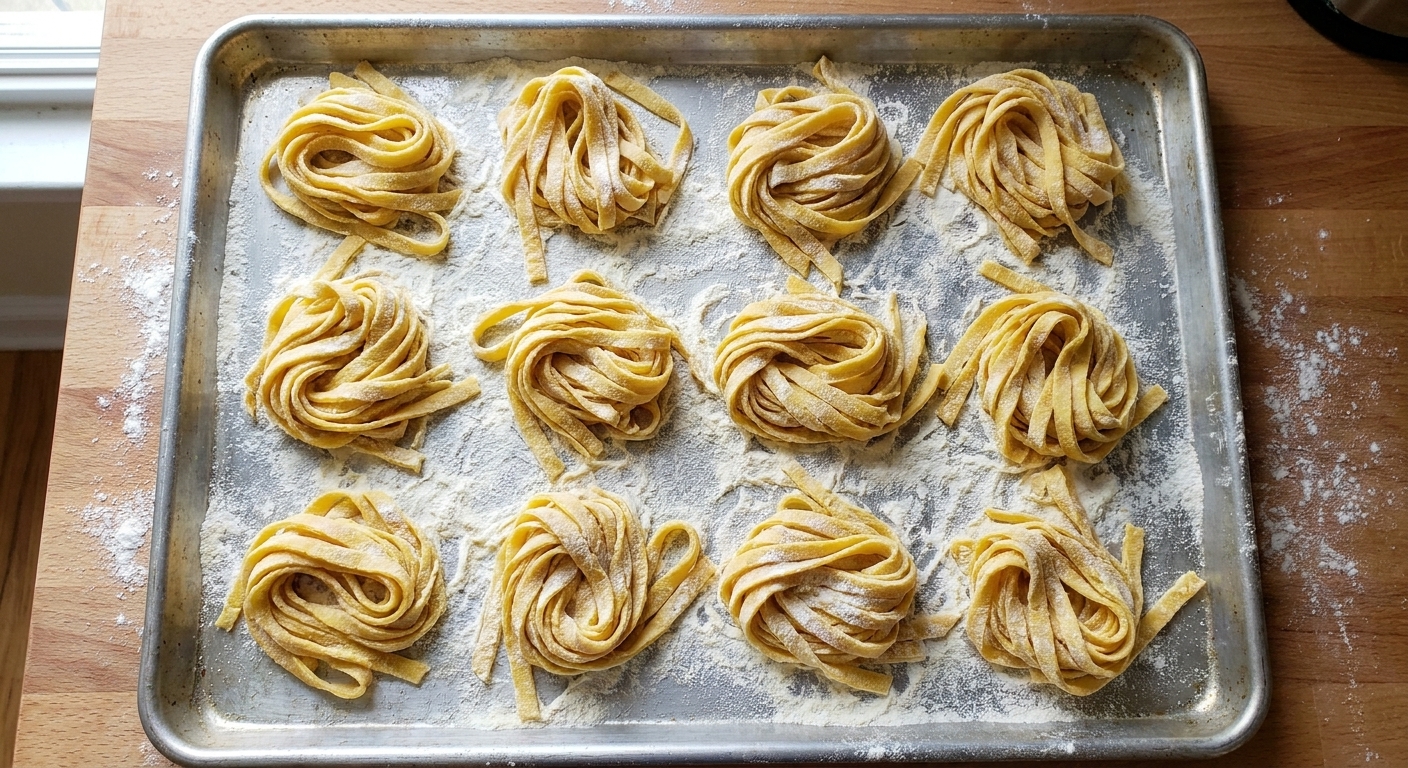
Simple hand-cut pappardelle
Skip the folding. Lay the sheet flat and cut long wide ribbons with a knife or pizza wheel. This is wonderfully rustic and very forgiving.
Lasagna sheets
Cut the rolled sheet into rectangles. Keep them separated with parchment and a light dusting of flour.
Quick ravioli tips
If you are going the stuffed route, a few small things make a big difference:
- Do not overfill. A teaspoon-ish per raviolo is often plenty.
- Press out air around the filling so they do not balloon or burst in the pot.
- Seal well with a little water (or a light egg wash), then press firmly.
Cooking fresh pasta
Fresh pasta cooks fast. Like, “set the table first” fast.
1) Salt the water well
Use a large pot of boiling water and salt it generously. This is where most of the seasoning happens.
2) Cook briefly
Fresh noodles usually take 1 to 3 minutes, depending on thickness. Taste early. You want tender with a slight bite.
3) Finish in the sauce
Reserve a cup of pasta water, then transfer the noodles directly into your sauce. Toss for 30 to 60 seconds with a splash of pasta water to create that glossy, clingy magic.
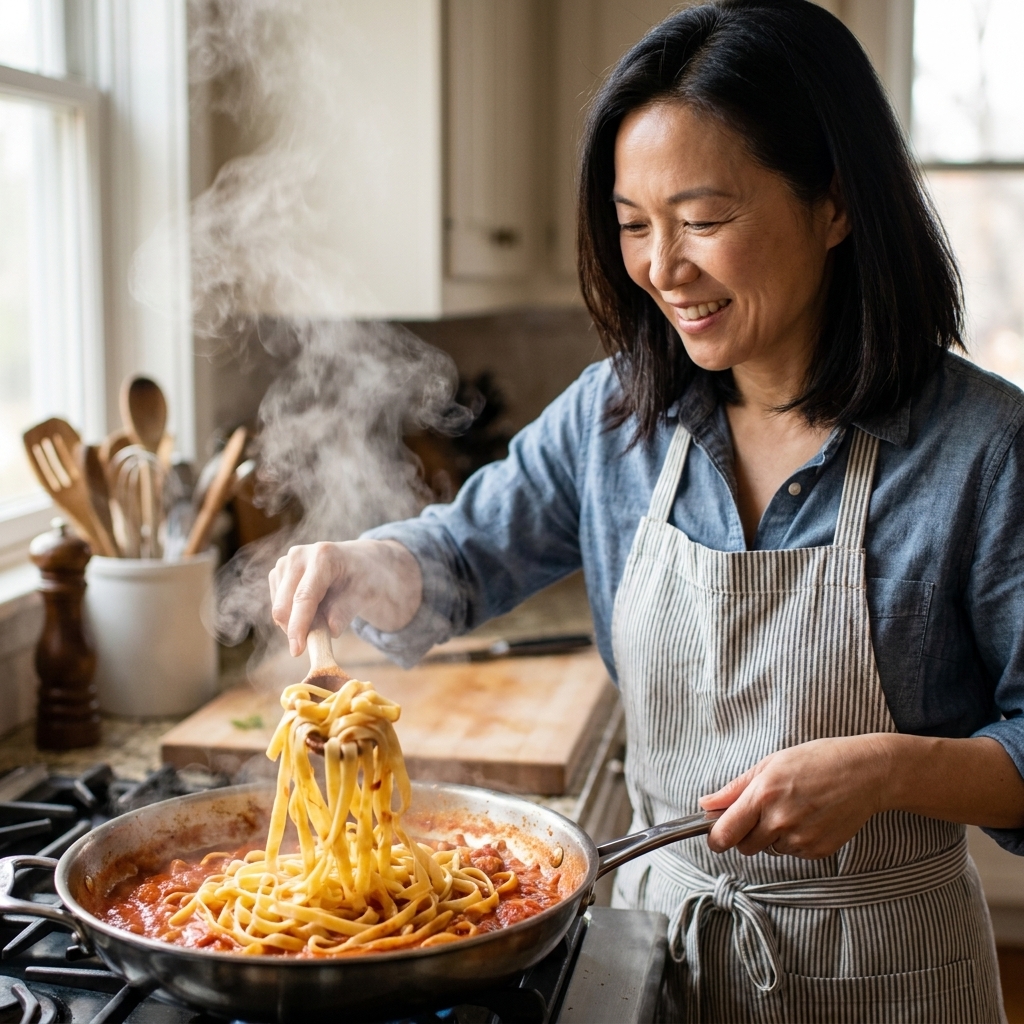
Little tip from my messy-cook heart: Use tongs for long noodles and a spider strainer if you have one. Less splashing, more control.
Sauces that love fresh pasta
- Brown butter and sage: Especially good with egg pasta. Nutty, cozy, fast.
- Simple tomato sauce: Garlic, olive oil, crushed tomatoes, basil. Let the pasta shine.
- Cacio e pepe: Pecorino + black pepper + starchy water. It is a technique, not a recipe.
- Ragù: Fresh tagliatelle and a slow-simmered meat sauce is an Italian love story.
Troubleshooting
My dough is too dry and cracking
Add water 1 teaspoon at a time while kneading. Cracking often means it just needs more hydration and a rest.
My dough is sticky
Dust lightly with flour and keep kneading. Sticky dough often becomes smooth after a few minutes of kneading and a rest.
The sheet keeps shrinking back
That is tight gluten. Cover and rest the dough (or the partially rolled sheet) for 10 to 15 minutes, then continue.
My noodles are sticking together
Use a little more flour or semolina when shaping. Spread noodles out on a floured sheet pan, or make loose nests with space between.
My pasta is gummy
Usually one of a few things: water not boiling hard enough, overcrowding the pot, overcooking, or sheets that are too thick. Another sneaky one is too much flour dusting clinging to the noodles. Shake off excess flour before cooking, and do not be afraid to roll a touch thinner next time.
Variation: semolina and water (no eggs)
If you want a traditional egg-free dough, this one is beautifully simple and great for hand-shaped pasta.
Ingredients
- 300 g durum semolina flour (or semola rimacinata if you can find it)
- 150 to 170 g warm water (start with 150 g)
- Pinch of salt (optional)
Method
Make a well, add water gradually, mix until shaggy, then knead 8 to 10 minutes. Rest 30 minutes. Shape into orecchiette or cavatelli, or roll and cut.
Storing fresh pasta
Short-term (same day)
Keep shaped pasta on a floured sheet pan, loosely covered with a towel, up to a few hours at cool room temperature. If your kitchen is warm, keep it closer to 2 hours, or move it to the fridge or freezer.
Refrigerator
Fresh pasta can be refrigerated, but it can also stick and oxidize. If you need to store it, dust well, place in a container, and use within 24 hours.
Freezer (best option)
Freeze pasta in nests or flat portions on a sheet pan until firm, then transfer to a freezer bag. Cook from frozen, adding about 30 to 60 seconds.
Fresh pasta FAQ
Do I need a pasta machine?
No. A rolling pin works. A machine just makes thin, even sheets easier, especially for ravioli and lasagna.
Can I use only all-purpose flour?
Yes. It is a little less silky than some 00 flours, but still absolutely delicious. If you want more structure, add 20 to 30% semolina.
How do I know when the dough is kneaded enough?
It should feel smooth and elastic, not shaggy. If you press a fingertip in, it should slowly spring back.
Why does my dough have little dry bits?
Usually the eggs were not fully incorporated before the dough formed. Next time, pull flour into the eggs more gradually. For now, knead a little longer and add a few drops of water if needed.
Is fresh pasta always better than dried?
Different, not always “better.” Fresh is tender and rich. Dried durum pasta has that firm al dente bite that is perfect for many sauces. Both belong in your kitchen.
Your next step
If this is your first time, make fettuccine. It is the friendliest shape, and you will learn everything you need: dough feel, resting, rolling, and cooking timing. And when you twirl that first forkful of pasta you made with your own hands, it is hard not to feel a little proud.
Now go put a pot of water on. Fresh pasta waits for no one.